Wednesday, 5 November 2014

Mmmmm, Ethiopian food!

So, ever since I got back I've wanted to try making Ethiopian food. The staple food is injera, a flat bread made from a grain called teff. Actually at Guassa it was too cold for teff so they grew wheat and made injera from that, but teff is traditional so I wanted to use that. You can't buy teff flour at Safeway so I ordered some online and it came last week.

Anyway, the idea is you have a big round flat bread thing, then you put stew or meat or any good thing on top. You eat it with your hands, tearing off pieces of injera to scoop up the stew. It is actually possible to eat it without making much of a mess.


I mixed the teff flour and water and yeast to make a sourdough starter, which had to be fed more flour and water over the course of a few days.


Then cooked it like pancakes except you don't flip them. The lid lets the top get steamed so they cook all the way through. They are supposed to be bigger, maybe 50 cm diameter, but this was the biggest pan I had.

Some finished injera. The bubble holes are important for the texture. The cracks in the one at the back are not supposed to happen. The batter was too thick at first so the early ones were not as good.

I also made doro wat (Ethiopian spicy chicken stew). It was tasty but not as red in colour as the authentic version. I must not have got the spices right. I couldn't find the proper berbere peppers so I just used chili powder and paprika. All in all it tasted good and brought back happy memories.


Here's the recipes I used. The authors seem to have done better than I did. I will have to try again!
Doro Wat Recipe
Injera Recipe


This was at a fancy restaurant near Addis Ababa. We had shekla tibs (fried beef with hot coals underneath so it stays hot) and you can see the injera rolled up on the side of the plate. Dawit's family and the restaurants I visited in the city serve the injera rolled up on the side. The first course was raw beef but I didn't get a picture. I can't wait to go back!

Wednesday, 13 August 2014

Pilgrims

So much happened in Ethiopia but I was mostly too busy living it to blog about it, so I have a few stories saved up. This is from last November.

I was out with the monkeys one day and there were lots of people walking past. There must have been a few thousand people over the course of the day, all converging onto the road heading south. They all wore white, which is the usual colour around Guassa, but today it was extra clean white. I asked about it and apparently they were going to see an angel. I've never seen an angel so I wasn't about to miss it.


It turned out they were building a huge church, possibly to honour the angel. It will take a few years to finish it. They have special services twice a year to raise money for building materials. It looks like it's going to be made of concrete but what I saw was mostly scaffolding made of eucalyptus poles.


There were thousands of people at the church service. Many people had velvet ceremonial umbrellas with sparkly gold bits. Others brought their regular rain umbrellas, which are used against the sun as much as the rain. The bishop is under the big white umbrella.


I never did get to see the angel. All the people must have scared it away.

Ethiopian churches are really beautifully decorated. These paintings are inside a big church in Addis Ababa. I think it's weird that Jesus and all the saints are painted as white people.

Under the Madonna painting you can see the king and queen who built the church. I think it's weird that they are painted looking Ethiopian while the saints above look European. Some of the saints were Ethiopian too but they are painted as white people. I think that's St Yared on the right, with the drum; shouldn't he be darker-skinned? The man on the horse below is St George, Ethiopia's patron saint.

Looking back at these pictures I can almost smell the frankincense. I miss frankincense. I don't usually like smoky things but that smoke smells really good.

Sunday, 8 June 2014

Baby Monkey, Baby Monkey!


 I'm back in Lethbridge now and recovering from all the excitement so I wanted to post some more gelada pictures. Here's what baby geladas look like...


Babies spend a lot of time playing. These two are showing the open-mouthed play face. One of the baby geladas' favourite games is a sort of "king of the castle" game. Any sort of rock or steep slope will do, and the babies and juveniles wrestle and jump or push each other off. They are tough little guys and falling a few meters doesn't seem to hurt them. You can see the camp road in the background.


Geladas are born with black fur that gradually lightens to the usual brown colour. The black one at the back is younger than his playmates.


When you're all tired out it's good to get a ride. Twisting your tail around mom's provides added support.


Babies hold onto the mother's fur even while sleeping. They can support themselves within a few days after birth, leaving the mother's hands free for foraging. At first they ride on the mother's belly, with easy access to her nipples so they can suckle almost constantly. Bigger infants usually ride on the mother's back, like this one on the right has just learned to do.

Wednesday, 19 February 2014

Geladas and Friends

My, what big teeth you have!
 This is one of my favourite photos, a male gelada showing off his big pointy canines. I got this printed in Addis Ababa and I've been showing it off whenever people ask me what I'm doing in Ethiopia. Most people in the city have never seen geladas and don't know much about them. Some popular questions:

Does that live in Ethiopia? (Yes, they are actually endemic to Ethiopia.)

Aren't they dangerous? (No, but maybe the picture doesn't make the best impression. He's just yawning!)

Do they have males and females, like people? (Yes. I don't know why that seems strange, when most familiar animals come in two sexes, but I've been asked more than once.)


Geladas are indisputably Guassa's finest animals, but there are other species present. All the herbivores mostly get along, except for occasionally startling each other. The geladas just ignored these cattle.


The Ethiopian Wolf is the world's rarest canid so I'm really lucky to see them somewhat regularly. They have walked right through camp several times and they can often be heard howling at night. Contrary to what you may have seen on TV, the wolves eat rodents, not geladas. These pictures show a wolf hunting among the geladas, while the monkeys keep right on grazing.


 Guassa also has lots of birds. Tawny eagles are one of the most common.  There are also lammergyres and blue winged geese, but I don't have any good pics of these yet.

The flora of Guassa is as unique as its fauna. These giant lobelia plants grow taller than me. They kind of look like the truffula trees from The Lorax, but less soft and more spiky. When they bloom the flower makes a spike almost two feet long that grows up from the top of the leafy part.


Friday, 19 July 2013

You Don't See That Every Day


The other day I spotted some traffic cones around a small hole in the sidewalk. Banff is full of creative and unconventional people, and you see the strangest stuff sometimes, but this was definitely one of the more baffling things. When I got closer there seemed to be a piece of paper in the hole...

 It's a bit hard to see but this was the best picture I could get. Yes, the hole in the sidewalk contained a note: "Hi, I borrowed this brick to complete my house". The whole thing just raises so many questions, like Why?!? It had to take a bit of work to pry it the brick out, and what can you do with just one brick?
 

Then I saw this rare two-headed elk in the river, just two minutes from my house.


Here it is from another angle. Turns out it also has two bodies, very disappointing. You can see Mt Rundle in the background. It's one of Banff's well known mountains and I really want to climb it this summer.

Saturday, 22 June 2013

The Great Alberta Flood


Nobody was expecting a flood. It started raining on Wednesday, life went on, and then by Thursday morning we woke up to news of flood warnings, evacuations, roads closed and bridges destroyed. Banff is not as badly affected as some places. The park is flooded and you can't get out of town to the east, and a few buildings near the river are uninhabitable. We still have power and water and everything is open. The news from Canmore and Calgary sounds a lot worse though. Lots of people have had to evacuate and there are houses falling into the river in Canmore. Canmore was cut off completely for a while, but some buses and trucks were getting through yesterday. There were several helicopters circling over Banff, checking out the situation and looking for anyone who needed rescuing.


I'm not really affected by the flooding since I wasn't planning to leave town anytime soon, but it's always a weird feeling when there's a disaster around you. People naturally want to help but there isn't anything to help with at the moment, so all we can do is stand around in the park and gawk at the water.


I don't know why they bother with all the caution tape. If people are too dumb to notice eight inches of water on the path, I don't think a sign is going to to help them.


This park bench would be a good place to sit for lunch- some other day!

Tuesday, 12 March 2013

Madagascar Memories

Sadly, I am not in some exotic location right now,
but I wanted to post some more of my photos, so here are a few more of my happy memories.


Lemur on a taxi brousse! This is one of the lemurs on the ride home to KAFS to be fitted with a new radio collar. He spent most of the journey inside a big fabric bag to minimize stress, but I took the picture when they opened the bag quickly to check on him.


A small fraction of the bounty of lychees. Lychees were in season when I left Madagascar and you could get a shopping bag full for about a dollar. They are kind of addictive so when you eat one it's easy to just keep on eating them, like chips.


 This is one of my little gecko friends. There were always a few little green day geckos chasing each other on my tent or stalking insects in the thatch roof. This one is about as long as my hand and he caught a big insect, I think it might have been a dragonfly.


Run away, it's the evil duck! Some of the ducks in Kianjavato were the usual mallards and white domestic ducks, but there was also this black kind with weird red swellings on the face. This particular duck belonged to a family who kept a little store next door to KAFS. The volunteers would go to the store for cake (mmm, mango cake with chocolate icing!) and sandwiches, and this enormous duck was always there hissing at us and snaking its neck. It looked kind of demonic so I called it the evil duck.
 I have fond memories of drinking at Hotely on a Sunday afternoon. Sunday is market day in Kianjavato and everybody goes into town wearing their best clothes, going to see and be seen as much as to shop. Hotely is right in the middle of town and their porch has a great view combined with shelter from the sun or rain, and of course the cold beer. Looking at this picture I can almost hear the rain on the sheet metal roof, taste the Namaki coffee rum and Three Horses Beer, and smell the gutter you have to cross on a little plank bridge between the porch and the street. The street is usually packed solid with people on market day but this day everyone who could was waiting out the worst of the rain under whatever shelter they could find, so there were only a few people and the hotely dog out on the street. Also in the picture is the famous red car, maybe the only car for miles around. You could tell the guys driving it thought they were pretty cool, with Celine Dion blasting from the stereo.

Saturday, 3 November 2012

Havana

It is starting to rain more often. The rain is usually sudden and intense, then the weather clears right up. we had a really good rainbow last week, and I like this picture of it with Melanie, one of the other volunteers. The Malagasy word for rainbow is havana, which can also mean family. (The emphasis is on the first syllable, not like the Cuban city.) 

The fruit is starting to be ready, and you can sometimes get mangoes and papaya. The lychees are starting to get red, and I am just realizing how many lychee trees there are around Kianjavato. Hery told me they will be ripe November 23rd, but he might just be saying that so I stop asking him about it. I should get just the start of the lychees and pineapples before I have to leave.


Saturday, 6 October 2012

Fruit and Lemurs


We checked into the hotel in Fianarantsoa this afternoon, then proceeded straight to the patisserie. I got quiche, tamarind juice, and profiteroles. The place had a whole menu of ice cream treats, which we read, translated (all menus are in French here), discussed, and considered at length which one to order. Then the waitress informed us that they were out of everything except profiteroles. It wasn't too much of a hardship though. Have you had profiteroles? They are ice cream on pastry, with whipped cream on top. I am pleased to report it is as good as it sounds.

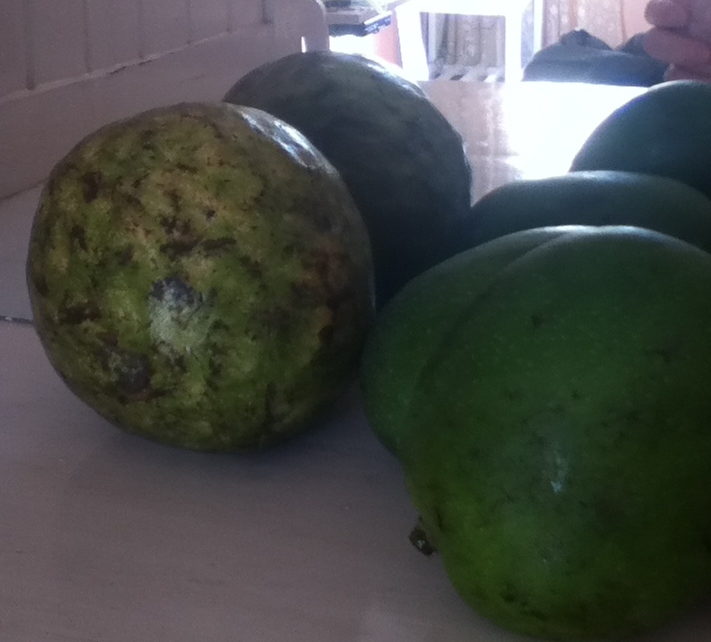
It is getting much warmer here in Madagascar, the days are longer and there is starting to be fruit. I thought of it being tropical here, but we are about 21 degrees south and it is actually quite seasonal. I got a coeur de boeuf, a sort of green fruit about the size of a grapefruit that looks like a cow's heart, or it would if a cow's heart looked like the lumpy green and black thing on the left of the photo. The brighter green things are mangoes. There are also pineapples and green spiky things I have never seen before. The seasons are later in Kianjavato but we should have fruit there soon. There have only been bananas since about June. We are starting to see cucumbers again, and the carrots are new fresh ones, and there are some weird dry little things like a cross between raisins and shrivelled crabapples.

MBP, the organization I am volunteering with, has a chance to get funding if people vote for our project. They talk about the black and white ruffed lemurs and the reforestation efforts, but my bamboo lemurs live in the same forest. Being here I can really see that the project makes a difference. People can see that the lemurs are worth more alive, bringing in researchers and tourists and providing jobs, so they do not eat them anymore. You can vote here if you like.

Last weekend there was a concert in Kianjavato, a guy named Tsiliva. Everyone I know was there and there was a lot of dancing. At one point two masked men, dressed as Michael Jackson and, we think, Osama bin Laden, pretended to attack the singer and he fought them off with a really funny display of karate. I guess this is just one of the things they do here. I am getting used to the idea that I won't understand a large part of the world around me.

I keep trying to photograph the baby lemurs but it is difficult because they are very small, the same colour as the mother, and usually silhouetted against the sky. They get bigger almost by the day though. I think they should attain maximum cuteness in the next month or so, as they will become more independently mobile but still quite tiny and babyish. The one on the left is an adult just finishing a big jump and catching hold of a branch.


Sunday, 23 September 2012

Baby Lemur, Baby Lemur!


We would like to congratulate PBC, a Greater Bamboo Lemur, on the birth of her new baby! We do not know yet if it is a boy or a girl. The baby is about the size of a chipmunk, with fur a bit darker than the adult animals. It has a tiny tail hardly bigger than a pencil but it already seems to be using the tail to help it maintain its balance as it clings to the mother's abdomen. It is hard to believe this tiny helpless thing will be leaping through the forest and playing with its friends in just a few months! The baby's older brother, born last September, seems indifferent to his new sibling. He still follows his mother around sometimes but he is more often foraging by himself or playing with the other juveniles.


 There are no baby pictures yet, but here is an unrelated shot of Hercules, one of our dominant males, scent marking. Male simus have large scent glands under their armpits that they like to rub on branches to mark their territory. Sometimes they mark their own tails too and you can really smell the musky scent wafting behind them as they move.

Here is Hercules (left) back in July when we put a new radio collar on him. The eyes are open because of the drug but the animal is still unconscious. He is recovering at this point and is starting to move and hold his head up. He was starting to hold on with the front legs (they have a really strong grip, even asleep) but the rear half of the body was still dead weight at this point.


Sunday, 9 September 2012

Another shitty day with the lemurs...


"What is excrement?" Theoluc asks me one day while our lemur is sleeping. My old partner left him a Malagasy-English dictionary and Theoluc is reading it to improve his English, but some of the translations are not clear. Apparently he is up to the letter E.

"Just a sec, I'm upside down." The ground under the sleeping animal's tree is too steep to sit on. I tried to sit, then lie down, then I squirmed around until my head ended up below my feet, a tree root digging into my shoulder and ants crawling on me from somewhere. Theoluc has found a perch that looks much better, and politely says nothing while I struggle upright.

"It means shit."

"As in "The animal is excrementing?""

"No, it's only the noun "shit", not the verb. Like "This is a piece of lemur excrement."" I pick up a bit of old dried lemur poo. Their poo is innocuous: the fresh stuff is like pellets of wet green plant matter and the old stuff looks like hay. It doesn't smell. Theoluc nods understanding and goes back to his dictionary.

I go back to staring lazily into the distance. It is hot, but very pleasant in the shade of the forest and when you are not moving. Insects make a loud background hum, the sort of noise you hardly notice. We are near the edge of the forest so I can look out across a field of tiny knobby trees. They are grown for biodiesel and nobody knows the English name.

Saturday, 11 August 2012

Crazy Busy Weeks


10-Aug-12
Camp seems empty and everyone is breathing a sigh of relief tonight. The last few weeks have been crazy. First Ed came for a few weeks and kept shouting at everyone and hiring dozens of workers to build and repair things around the camp. There are several new bridges over the drainage ditches, a concrete food storage building that is supposed to be rat-proof, lots of new sun shades for the tree nursery, and a large flat terrace carved out of the hill for a vegetable garden. KAFS is a work in progress and a permanent construction site, so every now and then you run into a new ditch or fence or people mixing cement.

The dart team showed up a few days after Ed. Most of the radio collars on our animals have dead batteries, and you have to shoot the animals with a tranquilizer dart to change the collars, so I got to cuddle some lemurs. Male bamboo lemurs have a strong musky smell from the large scent glands under their armpits, and they scent mark by rubbing their armpits on branches. They like to put their arms around you and hold on, even when half asleep, so after you hold a lemur you also smell like their territory. The technician changes the collar, checks the microchip and takes some measurements, then somebody needs to watch the animal carefully until until it recovers enough to be put into a pillowcase. Lemurs do not usually lie down so they feel better hanging from a tree in a pillowcase than lying in a cage.

The weird part is you can't put them into the pillowcase until they are strong enough to not get their necks into a position that blocks the airway, and they sometimes start crawling clumsily before they reach that point. Those ones need to be held and they like to cling to you. They have a very strong grip, even when drugged. They usually recover quite quickly and they can be released three hours after darting. The anaesthetic does weird things to the animals. For one thing their eyes are open the whole time, and you have to put special gunk to keep the eyes moist. Bamboo lemurs always seem to stick out their tongues, but the black and white ruffed lemurs don't. Oh, and one suddenly woke up and crawled off the scale while we were weighing it. Luckily Melanie grabbed it before it got very far.

We had one lemur that turned out to be old and sick and very skinny, and he slept a long time. I had him pressed against my chest for two hours to prevent hypothermia and the technician kept giving him IV fluids. I named him Elvis and he did finally wake up and we put him back in the forest where we got him. The next day we went back to check on him, and the signal from the radio collar was coming from the very spot where we released him. You can tell the direction of the signal very accurately and this signal was coming from the ground. Everybody went quiet and started combing through the bushes for a little furry body, but after a very long few minutes Theoluc came up with the collar. It must have fallen off within hours. I can confirm that Elvis is alive though: I have seen him twice since then, eating and chasing another lemur. He is visibly skinny and has a unique bald patch on his throat so I recognize him without the collar. We will not dart him again because he is not well. He is one of my favourites and I hope he hangs on a while longer.

 In case that wasn't enough excitement, the next arrival was a TV crew from the BBC. They brought at least 30 people and several tons of equipment and took the place over. They brought eight little British kids and filmed the kids watching lemurs and visiting a school and stuff. It's called Deadly Mission Madagascar, and we all had a good laugh about the title. It was somewhat interesting watching them and they were pretty good in the forest. The lemurs are really well habituated; they were fine with twenty people crashing throught the forest around them.

Anyway, everyone is gone now and it is just the usual dozen people at KAFS. The place seems a different without all the chaos, and hopefully we can get back to work as usual.

Saturday, 7 July 2012

Mmmmm, Food!


1 July 2012
I saw a tenrec today. Bark Bark the KAFS dog brought it in but we were able to rescue it and it seemed unharmed. It was a three striped tenrec, with soft spines like a hedgehog and a long narrow snout with whiskers. The whole animal looked kind of improbable somehow, like it was made from a bunch of random parts. We set it free in the bushes with a good head start from the dog.
It gets dark early in the tropical winter, maybe 5:30 or 6. There is no electricity so you have a choice of candles, head torches, or darkness. There is often a card game by candlelight after dinner but people rarely stay up much past eight. It is just as well, since we have to get up early to leave by 6:30.
We spent most of the afternoon playing Uno. It is a very complicated game and you need great reflexes to play your card before someone else beats you to it. We agreed that it was such a stressful and competitive game that you need a rest afterwards. I hope I can get people to play spades again. That was the last fad and it might be the most fun card game I know.
It is Saturday night and Wednesday and Saturday are supposed to be pasta night. We were all waiting eagerly for the best meal of the week, spagetti topped with oil, carrots, and green beans. I bought a jar of real tomato sauce last time I was in Fianarantsoa and it was going to be a real feast. Everyone looked so disappointed when the cook brought out plates of rice and salty carrots. I was warned the food was mostly rice and beans andd veg, but the beans are all too rare and the rice is invariably burned. We have quite reasonable ingredients and I could make a good meal with what we have, but we seldom get anything palatable. We were too disappointed to even feel like playing cards after dinner.
There are two little shops within a five minute walk and I'm sure the KAFS volunteers are a big source of revenue for them. You can get little packets of crunchy corn-based rings called Cracky. Sometimes they have Saltos, which may be the world's best soda crackers, or maybe I have just never been so hungry. We went into Kianjavato last night for Sheila's birthday and we got rum and coke and the hotel's entire supply of Saltos. We always thought that it was 4km to Kianjavato, but somebody recently told us it is only 3km, so the walk home from the bar is now one third shorter.
Prolemur simus is very cute but not very active. One day last week we followed the same animal all day. We found him just before 8 and sat down under his tree. Five hours later we got up and walked back to the road to get picked up. For all I know he might still be in the same tree. Yes, we are sure he is not dead: he was grooming himself briefly.
One of our animals unfortunately is dead though. It was probably killed by a fosa. We found the body easily because the radio collar was still working. There was not much left but part of the skull and some bedraggled fur and the big fluffy tail. That is nature for you but if I met that fosa I would like to punch it in the face. I was pretty mad that the stupid fosa picked the only animal in that group whose radio collar still worked. Now we can't find that group anymore without searching their entire terrritory, and unless we get very lucky that will take days of grueling effort. The upside is that the boss finally took notice of the deteriorating radio collar situation that we have been asking about for months. The dart team should be coming out to tranquilize some of the animals and replace the collars in July.

2 July 2012
Today was the first serious rain we have had since I got here. Drizzle and showers have been pretty common but today was the first real downpour. The animals tend not to move very much when it rains so we stood there and got soaked while they slept. I was told it would be hot here so I packed for hot rainy weather, but not much for cold rainy weather. Nothing dries properly here and it is really going to suck putting on my wet clothes tomorrow morning when it is about ten degrees outside. At least dinner was good.
It's weird: here I am in the Madagascar rainforest, this exotic place that I have always wanted to see, spending my days with one of the world's most endangered primates, but most of my thoughts revolve around food. It is a topic we can discuss every single day and we keep finding more to say. Rice pudding featured prominently today, not on the menu of course but in conversation. You can make a fair substitute by putting sweetened condensed milk and nutmeg on the breakfast rice. My Grandad talks about his field work, and having only spam and strawberry jam to eat. Those are luxury items here, totally worth the five hour taxi brousse ride to Fianarantsoa.

7 July 2012
We left early this morning for Fianar and got the fastest taxi brousse ever, about three and a half hours. The guy drove safely too, he just didn't keep stopping all the time. We got here in time for lunch and I have eaten a double cheeseburger, fresh pineapple smoothie, chocolate cake, lemon ice cream, processed cheese, mint candies, and half a custard bun. Dinner is in an hour or two so I have to stop and make room. I got sweet chili sauce and jam to put on the rice back at camp, probably not together. It is a good day.


Sunday, 17 June 2012

Still Alive!

Just a quick note to let everyone know I'm in town again. The internet has finally started working, right before we have to leave again, so we are madly trying to do everything. I will try and write something more next time!

Friday, 1 June 2012

Two weeks at KAFS


Rice fields on the way to Kianjavato
 Hello again! It has only been two weeks but it feels like I've been here forever. I am in Fianarantsoa now, the city where we come to upload our data. The hotel is pretty nice and they have ice cream here. The ice cream was totally worth the six hour taxi brousse ride. It is usually four hours but our taxi brousse had a flat tire. And needed more oil. And ran out of gas. And the starter didn't work. The driver tried to stop on hills but we had to push it twice to start the engine. The trip is probably less than 200 km but the road is all hairpin turns and huge potholes and several places are only one lane wide because the other lane washed away in a cyclone a few years ago.


The people who have been here a few months just drool over everything, but I don't think I have been here long enough. Food is a popular topic of conversation at KAFS. They feed us rice at almost every meal and a little bit of something healthy like beans or meat or veg, but mostly rice. Everyone has condiments to put with it to make it edible, like soy sauce or ketchup or sweetened condensed milk. I got some chicken stock cubes and vinegar in town today and I have high hopes for it. Sometimes there is salad and the vinegar from it really improves the rice. We talk about food a lot, the things we miss from home, and I dreamed about pot roast the other night.

I was going to take some pictures but I keep leaving my camera at the top. KAFS is built on a hill, with the main buildings at the bottom and the tent platforms scattered across the slope. Mine is almost at the top, so if I forget something it is a bit of a trek back up. The tent platforms have a wooden floor and a ravinala roof with room for clotheslines underneath as well as your tent. My tent is great. It has lots of mesh for ventilation and I brought a full twin-size air mattress so I have a real bed. It is winter here so it gets cold at night and I am really glad I brought my warm sleeping bag. It is really nice and cosy in there and sometimes I don't want to get up in the mornings, but when I do the view is amazing. In the mornings I wake up to the mist rolling across intensely green hills of rainforest dotted with the huge fans of the ravinala trees. There are a few houses and farms but they look very picturesque from a distance. Closer up you see the inescapable poverty: the houses are shacks and the kids and chickens and dogs are all too skinny. Everybody seems very friendly though.


A pomegranate tree in Tana
The rainforest is really something. There are large trees but also a lot of small saplings and a lot of bamboo. My impression might be biased though because my study animals spend most of their time in bamboo areas. The big bamboo is tree-sized, about 10 cm thick and maybe 20 m tall. The lemurs eat all the parts of the bamboo plant, and they make quite a racket eating the large woody stems. They also like fruit. One of the fantastic things about the tropics is the progression of amazing fruits. I missed lychee season, sadly, but I arrived near the end of orange season and near the beginning of pineapple season. Soon the jackfruits will be ripe and I am looking forward to trying that. A jackfruit is bigger than your head and they dangle from the tree branches on stems about a foot long. They are kind of yellowish with little blunt points all over the outside. The lemurs are eating them now but people have to wait a bit longer for them to be ripe. Oh, and a few jackfruits went mouldy at an early stage of development and they look an awful lot like a dead mouse.


George is not too sure about the spider tortoises...
On Sunday night there was a big party at the hotely in Kianjatvo so we went into the village. I never liked rum at home but the rum here is really good, especially with coke. It is also ridiculously cheap, one or two dollars for a 300 mL bottle. There was a live band and everyone was dancing. The roosters were crowing when we left and it slowly went from dark to light out on the walk home. We were late for breakfast and slept most of the day, since it was a holiday. I don't know what the holiday was but they have a lot of holidays here, several every month. People don't get paid very much but at least they get lots of time off.